VISIT US ON FACEBOOK!

OUR FACEBOOK PAGE--EYE ON WASHINGTON

Stephen Colbert-- Here.

Our "Vintage" Video Collection Click On Image

Our "Vintage" Video Collection Click On Image
Great Political Moments Caught For Your Pleasure

Thursday, November 3, 2011

This Is What Happens When Government Does NOT Listen To The People, But Instead To The Corporations


Occupy Oakland Violence: Peaceful Occupy Protests Degenerate Into Chaos

From Huffington Post 11-3-11 by 
TERENCE CHEA, LISA LEFF and TERRY COLLINS 


OAKLAND, Calif. — A protest that shut down the Port of Oakland to show the broadening reach of the Occupy Wall Street movement ended in violence when police in riot gear arrested dozens of protesters overnight who broke into a vacant building, shattered downtown windows, sprayed graffiti and set blazes along the way.
At least four protesters were hospitalized Thursday with various injuries, including one needing stitches after fighting with an officer, police said. Several officers were also injured but didn't need hospitalization.
"We go from having a peaceful movement to now just chaos," protester Monique Agnew, 40, said early Thursday.
Protesters also threw concrete chunks, metal pipes, lit roman candles and molotov cocktails, police said.
The far-flung movement of protesters challenging the world's economic systems and distribution of wealth has gained momentum in recent weeks, capturing the world's attention by shutting down one of the nation's busiest shipping ports toward the end of a daylong "general strike" that prompted solidarity rallies across the U.S.
Several thousands of people converged on the Port of Oakland, the nation's fifth-busiest harbor, in a nearly five-hour protest Wednesday, swarming the area and blocking exits and streets with illegally parked vehicles and hastily erected, chain-link fences afterward.
Port spokesman Isaac Kos-Read said evening operations had been "effectively shut down."
Port officials hoped to resume maritime operations Thursday "and that Port workers will be allowed to get to their jobs without incident. Continued missed shifts represent economic hardship for maritime workers, truckers, and their families, as well as lost jobs and lost tax revenue for our region."
Big trucks were backed up Thursday morning as footage on KGO-TV showed about a dozen protesters manning a chain link fence blocking a port entrance. Truck drivers argued with protesters, who said they planned to stay until at least 9 a.m.
Port officials could not immediately be reached for comment on the status of operations at the port.
Supporters in New York, Philadelphia, Los Angeles and elsewhere staged smaller-scale demonstrations. Each group said its protest was a show of support for the Oakland movement, which became a rallying point when an Iraq War veteran was seriously injured in a clash with police last week.
The larger Occupy movement has yet to coalesce into an organized association and until the port shut down had largely been limited scattershot marches, rallies and tent encampments since it began in September.
Organizers in Oakland viewed the strike and port shutdown as a significant victory. Police said that about 7,000 people participated in demonstrations throughout the day that were peaceful except for a few incidents of vandalism at local banks and businesses.
Boots Riley, a protest organizer, touted the day as a success, saying "we put together an ideological principle that the mainstream media wouldn't talk about two months ago."
His comments came before a group of protesters broke into the former Travelers Aid building in order to, as some shouting protesters put it, "reclaim the building for the people."
Riley, whose anti-capitalist views are well documented, considered the port shutdown particularly significant for organizers who targeted it in an effort to stop the "flow of capital."
The port sends goods primarily to Asia, including wine as well as rice, fruits and nuts, and handles imported electronics, apparel and manufacturing equipment, mostly from Asia, as well as cars and parts from Toyota, Honda, Nissan and Hyundai.
An accounting of the financial toll from the shutdown was not immediately available.
The potential for the chaos that ultimately erupted was not something Riley wanted to even consider.
"If they do that after all this ..." said Riley pausing cautiously, then adding, "They're smarter than that."
But the peace that abided throughout a sunny warm autumn Wednesday, as protesters hung a large black banner downtown that read: "DEATH TO CAPITALISM," did not last as a cool midnight approached.
Occupy protesters voicing anger over a budget trim that forced the closure of a homeless aid program converged on the empty building where it had been housed just outside of downtown.
They blocked off a street with wood, metal Dumpsters and other large trash bins, sparking bonfires that leapt as high as 15 feet in the air.
City officials later released a statement describing the spasm of unrest.
"Oakland Police responded to a late night call that protesters had broken into and occupied a downtown building and set several simultaneous fires," the statement read. "The protesters began hurling rocks, explosives, bottles, and flaming objects at responding officers."
Several businesses were heavily vandalized. Dozens of protesters wielding shields were surrounded and arrested.
Protesters ran from several rounds of tear gas and bright flashes and deafening pops that some thought were caused by "flash bang" grenades. Fire crews arrived and suppressed the protesters' flames.
Protesters and police faced off in an uneasy standoff until the wee hours of the morning.
In Philadelphia, protesters were arrested earlier Wednesday as they held a sit-in at the headquarters of cable giant Comcast.
In New York, about 100 military veterans marched in uniform and stopped in front of the New York Stock Exchange, standing in loose formation as police officers on scooters separated them from the entrance. On the other side was a lineup of NYPD horses carrying officers with nightsticks.
"We are marching to express support for our brother, (Iraq war veteran) Scott Olsen, who was injured in Oakland," said Jerry Bordeleau, a former Army specialist who served in Iraq through 2009.
The veterans were also angry that returned from war to find few job prospects.
"Wall Street corporations have played a big role in the wars in Iraq and Afghanistan," said Bordeleau, now a college student. He said private contractors have reaped big profits in those countries.
A New York Post editorial on Thursday called on protesters camped out in Manhattan to leave or have police evict them. "What began as a credible protest against bank bailouts, crony capitalism and the like has, in large measure, been hijacked by crazies and criminals," it said.
In Boston, college students and union workers marched on Bank of America offices, the Harvard Club and the Statehouse to protest the nation's burgeoning student debt crisis. They said total outstanding student loans exceed credit card debt, increase by $1 million every six minutes and will reach $1 trillion this year, potentially undermining the economy.
"There are so many students that are trying to get jobs and go on with their lives," said Sarvenaz Asasy, of Boston, who joined the march after recently graduating with a master's degree and $60,000 in loan debt. "They've educated themselves and there are no jobs and we're paying tons of student loans. For what?"
And among the other protests in Oakland, parents and their kids, some in strollers, joined in by forming a "children's brigade."
"There's absolutely something wrong with the system," said Jessica Medina, a single mother who attends school part time and works at an Oakland cafe. "We need to change that."
(http://eye-on-washington.blogspot.com)

This Is Why We Have The Occupy Movement-Barack Obama! Wake Up!


Thirty Of America's Most Profitable Companies Paid 'Less Than Zero' In Income Taxes In Last 3 Years: Report

From Huffington Post 11-3-11 by Jillian Berman

Many major corporations have managed to pay taxes at just over half of the corporate income tax rate, according to a new report.
Nearly 300 of the nation's most profitable companies paid an average tax rate of 18.5 percent from 2008 to 2010, less than half of the 35 percent corporate tax rate, according to a study by the Citizens for Tax Justice released Thursday. Of the 280 companies, 78 studied paid a tax rate of zero or less during at least one year of the three year period.
And thirty companies, the report says, had a negative income tax rate from 2008 to 2010, even though they took home a combined $160 billion in pre-tax profits.
The financial services industry netted the largest share -- at 16.8 percent -- of the $222.7 billion in total tax subsidies that the companies received, the study found. Wells Fargo took home the most tax subsidies of them all, raking in nearly $18 billion in tax breaks over the last three years.
Officials at some major corporations lashed out at the study's findings following its release. In a statement, GE called the report "inaccurate and and distorted," according to the Washington Post. Verizon spokesman Robert Varettoni, told WaPo that "findings in this and other recent reports have been more politically motivated than truthful."
The findings come as politicians wrangle over the best way to cut the nation's budget deficit. Republicans recently proposed lowering the corporate tax rate to 25 percent and paying for it by eliminating business tax breaks. A study by the Joint Committee on Taxation, requested by congressional Democrats, found that eliminating the business tax breaks alone wouldn't bring in enough revenue to make up for the lowered rate.
Republican presidential candidate Rick Perry said last month that if elected president he would cut the corporate tax rate to 20 percent. Perry told The New York Times that he didn't care that his tax plan could possibly increase income inequality. Another Republican presidential candidate, Herman Cain, vowed to slash the corporate tax rate as part of his 9-9-9 plan, which if enacted would cap sales tax, corporate income tax and personal income tax at 9 percent each.
Companies such as Apple and Google are lobbying Congress to pass a specific tax loophole known as a repatriation tax holiday that would allow corporations to avoid taxes on more than $1 trillion in offshore profits, Bloomberg reports. In exchange, the companies argue, companies would invest those dollars in the U.S.
U.S. corporations with foreign profits that amounted to 10 percent or more of their worldwide profits paid tax rates to foreign countries that were nearly one-third higher than the tax rates they paid to the U.S., the tax justice study found.
The Heritage Foundation, a conservative think tank, reversed its position on the repatriation tax holiday last month, saying that it wouldn't help to spur U.S. job growth or investment. The Treasury Department found that a similar tax holiday passed in 2004, did little to boost employment growth.
In fact, several companies that benefited from the 2004 law cut jobs in its wake. Dow Chemical, Verizon and Bank of America are just some of the 10 companies that slashed jobs after benefiting from a repatriation tax holiday, according to the Institute for Policy Studies.

– Thirty corporations paid less than nothing in aggregate federal income taxes over the entire 2008-10 period. These companies, whose pretax U.S. profits totaled $160 billion over the three years, included: Pepco Holdings (–57.6% tax rate), General Electric (–45.3%), DuPont (–3.4%), Verizon (–2.9%), Boeing (–1.8%), Wells Fargo (–1.4%) and Honeywell (–0.7%).

(G.E. Barack's most favored U.S. corporation, since he has put them in the White House, is number two!)
http://eye-on-washington.blogspot.com

Wednesday, November 2, 2011

War Is Bad For The Economy--Occupy Wall Street!

From Washingtonsblog.com
Click link below for more.....................

Nobel Prize-Winning Economist: “War Is Widely Thought To Be Linked To Economic Good Times … NONSENSE”

Contrary to a Common Myth, War is Bad for the Economy

Nobel prize winning economist Paul Krugman wrote yesterday:
Military spending does create jobs when the economy is depressed. Indeed, much of the evidence that Keynesian economics works comes from tracking the effects of past military buildups.
(Mr. Krugman has said the same thing many times in the past. And many other influential people havesaid the same thing.)
I am not a Nobel prize winning economist … but Joseph Stiglitz is.
Stiglitz wrote in 2003:
War is widely thought to be linked to economic good times. The second world war is often said to have brought the world out of depression, and war has since enhanced its reputation as a spur to economic growth. Some even suggest that capitalism needs wars, that without them, recession would always lurk on the horizon.
Today, we know that this is nonsense. The 1990s boom showed that peace is economically far better than war. The Gulf war of 1991 demonstrated that wars can actually be bad for an economy.
Stiglitz has also said that this decade’s Iraq war has been very bad for the economy. See this, this andthis.

A No-Brainer

This is a no-brainer, if you think about it.
We’ve been in Afghanistan for almost twice as long as World War II. We’ve been in Iraq for years longer than WWII. We’ve been involved in 7 or 8 wars in the last decade. And yet still in a depression. (And see this).
If wars really helped the economy, don’t you think things would have improved by now?
Indeed, the Iraq war alone could end up costing more than World War II. And given the other wars we’ve been involved in this decade, I believe that the total price tag for the so-called “War on Terror” will definitely support that of the “Greatest War”.

Additional Reasons War Is Bad for the Economy

The New Republic noted in 2009:
Conservative Harvard economist Robert Barro has argued that increased military spending during WWII actually depressed other parts of the economy.
Also from the right, Robert Higgs has done good work showing that military spendingwasn’t the primary source of the recovery and that GDP growth during WWII has been “greatly exaggerated.”
And from the left, Larry Summers and Brad Delong argued back in 1988 that “five-sixths of the decline in output relative to the trend that occurred during the Depression had been made up before 1942.”
Economist James Galbraith has shown that war always causes inflation, which hurts the average American:
Inflation applies the law of the jungle to war finance. Prices and profits rise, wages and their purchasing power fall. Thugs, profiteers and the well connected get rich. Working people and the poor make out as they can. Savings erode, through the unseen mechanism of the “inflation tax” — meaning that the government runs a big deficit in nominal terms, but a smaller one when inflation is factored in.
As I noted last year:
All of the spending on unnecessary wars adds up.
The U.S. is adding trillions to its debt burden to finance its multiple wars in Iraq, Afghanistan, Yemen, etc.
Two top American economists – Carmen Reinhart and Kenneth Rogoff – show that the more indebted a country is, with a government debt/GDP ratio of 0.9, and external debt/GDP of 0.6 being critical thresholds, the more GDP growth drops materially.
Specifically, Reinhart and Rogoff write:
The relationship between government debt and real GDP growth is weak for debt/GDP ratios below a threshold of 90 percent of GDP. Above 90 percent, median growth rates fall by one percent, and average growth falls considerably more. We find that the threshold for public debt is similar in advanced and emerging economies…
Indeed, it should be obvious to anyone who looks at the issue that deficits do matter.
A PhD economist [Michel Chossudovsky] told me:
War always causes recession. Well, if it is a very short war, then it may stimulate the economy in the short-run. But if there is not a quick victory and it drags on, then wars always put the nation waging war into a recession and hurt its economy.
You know about America’s unemployment problem. You may have even heard that the U.S. may very well have suffered a permanent destruction of jobs.
But did you know that the defense employment sector is booming?
As I pointed out in August, public sector spending – and mainly defense spending – has accounted for virtually all of the new job creation in the past 10 years:
The U.S. has largely been financing job creation for ten years. Specifically, as the chief economist for BusinessWeek, Michael Mandel, points out, public spending has accounted for virtually all new job creation in the past 10 years:
longjobs1 Nobel Prize Winning Economist: War Is Widely Thought To Be Linked To Economic Good Times ... NONSENSE


Private sector job growth was almost non-existent over the past ten years. Take a look at this horrifying chart:
Between May 1999 and May 2009, employment in the private sector sector only rose by 1.1%, by far the lowest 10-year increase in the post-depression period.
It’s impossible to overstate how bad this is. Basically speaking, the private sector job machine has almost completely stalled over the past ten years. Take a look at this chart:
longjobs2 Nobel Prize Winning Economist: War Is Widely Thought To Be Linked To Economic Good Times ... NONSENSE


Over the past 10 years, the private sector has generated roughly 1.1 million additional jobs,
 or about 100K per year. The public sector created about 2.4 million jobs. 
But even that gives the private sector too much credit. Remember that the private 
sector includes health care, social assistance, and education, all areas which receive 
a lot of government support. Most of the industries which had positive job growth 
over the past ten years were in the HealthEdGov sector. In fact, financial job growth 
was nearly nonexistent once we take out the health insurers.
Let me finish with a final chart.
longjobs4 Nobel Prize Winning Economist: War Is Widely Thought To Be Linked To Economic Good Times ... NONSENSE
Without a decade of growing government support from rising health and education spending and soaring budget deficits, the labor market would have been flat on its back.
Indeed, Former Secretary of Labor Robert Reich lamented last year
America’s biggest — and only major — jobs program is the U.S. military.
Back to my essay:
Raw Story argues that the U.S. is building a largely military economy:
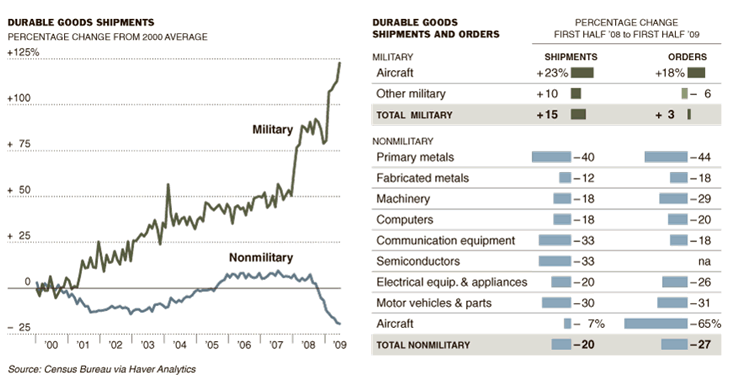
The use of the military-industrial complex as a quick, if dubious, way of jump-starting the economy is nothing new, but what is amazing is the divergence between the military economy and the civilian economy, as shown by this New York Times chart.
In the past nine years, non-industrial production in the US has declined by some 19 percent. It took about four years for manufacturing to return to levels seen before the 2001 recession — and all those gains were wiped out in the current recession.
By contrast, military manufacturing is now 123 percent greater than it was in 2000 — it has more than doubled while the rest of the manufacturing sector has been shrinking…
It’s important to note the trajectory — the military economy is nearly three times as large, proportionally to the rest of the economy, as it was at the beginning of the Bush administration. And it is the only manufacturing sector showing any growth. Extrapolate that trend, and what do you get?
The change in leadership in Washington does not appear to be abating that trend…[121]
So most of the job creation has been by the public sector. But because the job creation has been financed with loans from China and private banks, trillions in unnecessary interest charges have been incurred by the U.S.And this shows military versus non-military durable goods shipments:
us collapse 18 11 Nobel Prize Winning Economist: War Is Widely Thought To Be Linked To Economic Good Times ... NONSENSE
[Click here to view full image.]
So we’re running up our debt (which will eventually decrease economic growth), but the only jobs we’re creating are military and other public sector jobs.
PhD economist Dean Baker points out that America’s massive military spending on unnecessary and unpopular wars lowers economic growth and increasesunemployment:
Defense spending means that the government is pulling away resources from the uses determined by the market and instead using them to buy weapons and supplies and to pay for soldiers and other military personnel. In standard economic models, defense spending is a direct drain on the economy, reducing efficiency, slowing growth and costing jobs.
A few years ago, the Center for Economic and Policy Research commissioned Global Insight, one of the leading economic modeling firms, to project the impact of a sustained increase in defense spending equal to 1.0 percentage point of GDP. This was roughly equal to the cost of the Iraq War.
Global Insight’s model projected that after 20 years the economy would be about 0.6 percentage points smaller as a result of the additional defense spending. Slower growth would imply a loss of almost 700,000 jobs compared to a situation in which defense spending had not been increased. Construction and manufacturing were especially big job losers in the projections, losing 210,000 and 90,000 jobs, respectively.
The scenario we asked Global Insight [recognized as the most consistently accurate  forecasting company in the world] to model turned out to have vastly underestimated the increase in defense spending associated with current policy. In the most recent quarter, defense spending was equal to 5.6 percent of GDP. By comparison, before the September 11th attacks, the Congressional Budget Office projected that defense spending in 2009 would be equal to just 2.4 percent of GDP. Our post-September 11th build-up was equal to 3.2 percentage points of GDP compared to the pre-attack baseline. This means that the Global Insight projections of job loss are far too low…
The projected job loss from this increase in defense spending would be close to 2 million. In other words, the standard economic models that project job loss from efforts to stem global warming also project that the increase in defense spending since 2000 will cost the economy close to 2 million jobs in the long run.
The Political Economy Research Institute at the University of Massachusetts, Amherst has also shown that non-military spending creates more jobs than military spending.
So we’re running up our debt – which will eventually decrease economic growth – and creating many fewer jobs than if we spent the money on non-military purposes.
As I wrote last year:
It is ironic that America’s huge military spending is what made us an empire … but our huge military is what is bankrupting us … thus destroying our status as an empire.
Even Admiral Mullen seems to agree:
The Pentagon needs to cut back on spending.
“We’re going to have to do that if it’s going to survive at all,” Mullen said, “and do it in a way that is predictable.”
Indeed, Mullen said:
For industry and adequate defense funding to survive … the two must work together. Otherwise, he added, “this wave of debt” will carry over from year to year, and eventually, the defense budget will be cut just to facilitate the debt.
Former Secretary of Defense Robert Gates agrees as well. As David Ignatius wrote in the Washington Post in May:
After a decade of war and financial crisis, America has run up debts that pose a national security problem, not just an economic one.
***
One of the strongest voices arguing for fiscal responsibility as a national security issue has been Defense Secretary Bob Gates. He gave a landmark speech in Kansas on May 8, invoking President Dwight Eisenhower’s warnings about the dangers of an imbalanced military-industrial state.
“Eisenhower was wary of seeing his beloved republic turn into a muscle-bound, garrison state — militarily strong, but economically stagnant and strategically insolvent,” Gates said. He warned that America was in a “parlous fiscal condition” and that the “gusher” of military spending that followed Sept. 11, 2001, must be capped. “We can’t have a strong military if we have a weak economy,” Gates told reporters who covered the Kansas speech.
On Thursday the defense secretary reiterated his pitch that Congress must stop shoveling money at the military, telling Pentagon reporters: “The defense budget process should no longer be characterized by ‘business as usual’ within this building — or outside of it.”
While some might want to start another war, America’s top military leaders and economists say that would be a very bad idea.
Indeed, military strategists have known for 2,500 years that prolonged wars are disastrous.
Note 1: Security experts – conservative hawks and liberal doves alike – agree that waging war in the Middle East weakens national security and increases terrorism. See this, this, this, this, this, this andthis.
Terrorism – in turn – terrorism is bad for the economy.  Specifically, a study by Harvard and the National Bureau of Economic Research (NBER) points out:
From an economic standpoint, terrorism has been described to have four main effects (see, e.g., US Congress, Joint Economic Committee, 2002). First, the capital stock (human and physical) of a country is reduced as a result of terrorist attacks. Second, the terrorist threat induces higher levels of uncertainty. Third, terrorism promotes increases in counter-terrorism expenditures, drawing resources from productive sectors for use in security. Fourth, terrorism is known to affect negatively specific industries such as tourism.
The Harvard/NBER concludes:
In accordance with the predictions of the model, higher levels of terrorist risks are associated with lower levels of net foreign direct investment positions, even after controlling for other types of country risks. On average, a standard deviation increase in the terrorist risk is associated with a fall in the net foreign direct investment position of about 5 percent of GDP.
So the more unnecessary wars American launches and the more innocent civilians we kill, the less foreign investment in America, the more destruction to our capital stock, the higher the level of uncertainty, the more counter-terrorism expenditures and the less expenditures in more productive sectors, and the greater the hit to tourism and some other industries.
Terrorism has contributed to a decline in the global economy (for example, European Commission, 2001).
So military adventurism increases terrorism which hurts the world economy. And see this.
(http://eye-on-washington.blogspot.com)