VISIT US ON FACEBOOK!

OUR FACEBOOK PAGE--EYE ON WASHINGTON

Stephen Colbert-- Here.

Our "Vintage" Video Collection Click On Image

Our "Vintage" Video Collection Click On Image
Great Political Moments Caught For Your Pleasure

Monday, March 26, 2012

More US drilling didn't drop gas price

Former Governor Mitt Romney continues to pretend to be a devote Mormon but instead, he is a continuous liar and political fraud. He has no ethical consciousness, since he would rather lie than tell the truth. Here is one example among many. The GOP is filled with these liars. The Ging-grinch is another.

3-21-12 from CBS News by Associated Press writers Dina Cappiello and Matthew Daly in Washington and Jonathan Fahey in New York contributed to this report.


(CBS/AP) WASHINGTON - It's the political cure-all for high gas prices: Drill here, drill now. But more U.S. drilling has not changed how deeply the gas pump drills into your wallet, math and history show.
A statistical analysis of 36 years of monthly, inflation-adjusted gasoline prices and U.S. domestic oil production by The Associated Press shows no statistical correlation between how much oil comes out of U.S. wells and the price at the pump.
If more domestic oil drilling worked as politicians say, you'd now be paying about $2 a gallon for gasoline. Instead, you're paying the highest prices ever for March.
Political rhetoric about the blame over gas prices and the power to change them -- whether Republican claims now or Democrats' charges four years ago -- is not supported by cold, hard figures. And that's especially true about oil drilling in the U.S. More oil production in the United States does not mean consistently lower prices at the pump.
Sometimes prices increase as American drilling ramps up. That's what has happened in the past three years. Since February 2009, U.S. oil production has increased 15 percent when seasonally adjusted. Prices in those three years went from $2.07 per gallon to $3.58. It was a case of drilling more and paying much more.
U.S. oil production is back to the same level it was in March 2003, when gas cost $2.10 per gallon when adjusted for inflation. But that's not what prices are now.
That's because oil is a global commodity and U.S. production has only a tiny influence on supply. Factors far beyond the control of a nation or a president dictate the price of gasoline.
When you put the inflation-adjusted price of gas on the same chart as U.S. oil production since 1976, the numbers sometimes go in the same direction, sometimes in opposite directions. If drilling for more oil meant lower prices, the lines on the chart would consistently go in opposite directions. A basic statistical measure of correlation found no link between the two, and outside statistical experts confirmed those calculations.
"Drill, baby, drill has nothing to do with it," said Judith Dwarkin, chief energy economist at ITG investment research. Two other energy economists said the same thing and experts in the field have been making that observation for decades.
The statistics directly contradict the title of GOP presidential candidate Newt Gingrich's 2008 book "Drill Here, Drill Now, Pay Less," as well as the campaign-trail claims from the GOP presidential candidates.
Earlier this month, GOP front-runner Mitt Romney said of his solution to higher gas prices: "I can cut through the baloney ... and just tell him, 'Mr. President, open up drilling in the Gulf, open up drilling in ANWR (the Arctic National Wildlife Refuge). Open up drilling in continental shelf, drill in North Dakota, drill in Oklahoma and Texas.'"
Sen. Lisa Murkowski, R-Alaska, said on the Senate floor last week, "With oil prices above $100 a barrel and gasoline soaring toward $4 a gallon, greater production is not a political opportunity, it is a legislative imperative."
Supporters of the controversial Keystone XL pipeline say it would bring 25 million barrels of oil to the United States a month. That's the same increase in U.S. production that occurred between February and November last year. Monthly gas prices went up a dime a gallon in that time.
The late 1980s and 1990s show exactly how domestic drilling is not related to gas prices.
Seasonally adjusted U.S. oil production dropped steadily from February 1986 until three years ago. But starting in March 1986, inflation-adjusted gas prices fell below the $2-a-gallon mark and stayed there for most of the rest of the 1980s and 1990s. Production between 1986 and 1999 dropped by nearly one-third. If the drill-now theory were correct, prices should have soared. Instead they went down by nearly a dollar.
The AP analysis used Energy Department figures for regular unleaded gas prices adjusted for inflation to 2012 dollars, oil production and oil demand. The figures go back to January 1976, the earliest the Energy Department keeps figures on unleaded gas prices. University of South Carolina statistics professor John Grego, New York University statistics professor Edward Melnick and David Peterson, a retired Duke University statistics professor, looked at the analysis, ran their own calculations, including several complicated formulas, and came to the same conclusion.
When U.S. production goes up, the price of gas "is certainly not going down," Melnick said. "The data does not suggest that whatsoever."
The calculations "help make the point that U.S. production and demand have little to do with the price of gasoline in the U.S., and lend support to the notion that there is not a great deal we in the U.S., acting alone, can do to affect the price of gasoline," Peterson wrote in an email. He pointed out that Energy Department figures show that gas prices in the U.S. seem to rise and fall similarly to gas prices in Europe, showing that it has little to do with American drilling.
And that's the key. It's a world market, economists say.
Unlike natural gas or electricity, the United States alone does not have the power to change the supply-and-demand equation in the world oil market, said Christopher Knittel, a professor of energy economics at MIT. American oil production is about 11 percent of the world's output, so even if the U.S. were to increase its oil production by 50 percent -- that is more than drilling in the Arctic, increased public-lands and offshore drilling, and the Canadian pipeline would provide -- it would at most cut gas prices by 10 percent.
"There are not many markets where the United States can't impose its will on market outcomes," Knittel said. "This is one we can't, and it's hard for the average American to understand that and it's easy for politicians to feed off that."
If drilling activity rises around the globe for a sustained period of time, gasoline prices can fall as that new supply eventually finds its way to market, but the U.S. can't do it alone, oil analysts say.
Politicians -- especially those in the party that's not occupying the White House -- have long harped on high gas prices when expedient. Then-Sen. Barack Obama said in 2008, when he was running for president, that "here in Ohio, you're paying nearly $3.70 a gallon for gas, 2-1/2 times what it cost when George Bush took office."
But Obama, who has seen gas prices go up 73 percent since he took office, was singing a different tune last week in his weekly radio address: "The truth is: The price of gas depends on a lot of factors that are often beyond our control. Unrest in the Middle East can tighten global oil supply. Growing nations like China or India adding cars to the road increases demand. But one thing we should control is fraud and manipulation that can cause prices to spike even further."
The political party of the president doesn't seem to matter to the price at the pump either. Since 1976, the average monthly gas price, adjusted for inflation, during Democratic presidencies has been $2.25; under Republicans it's been $2.34. Obama had the steepest monthly average at $3.05 and Bill Clinton the cheapest at $1.68.
When Bush and running mate Dick Cheney campaigned in 2000, they argued that as oil executives they could get oil prices down, with Bush saying, "I would work with our friends in OPEC to convince them to open up the spigot, to increase the supply."
Yet it was during the last few months of Bush's term in 2008 that gas prices hit their highest: $4.27 when adjusted for inflation.
(http://eye-on-washington.blogspot.com)

A Demand Side Revolution?

3-23-12 by Shareholders Unite from Seeking Alpha


First, we had the supply-side revolution. Basically, this was a movement started with one very reputable economist (Robert Mundell) and a few others, like Jude Wanninski and Arthur Laffer (for a short history, see Bruce Barlett). The basic idea is simple: Tax cuts pay for themselves.
According to Wanninski, each of the main US political parties needed to be a sort of Santa Claus. The Democrats were the spending Santa, but the Republicans should become the tax-cut Santa. The idea was taken up by the influential Irving Kristol and, after spending the 1970s in the political wilderness, it became policy under Ronald Reagan.
Not everybody was immediately taken in. Vice president George Bush famously described it as "voodoo economics," and when he became president he (despite a fair bit of "lip reading"), he raised taxes. But one can say that the idea has renewed currency in the Republican party today (despite the fact that the evidence on its effectiveness isn't terribly encouraging, tax cuts rarely pay for themselves).
However, now the economic forces are such that ideas have been formed pointing to a "demand side" economics going beyond mainstream Keynesianism. The latter (in its policy form) is simply the idea that economic policy should be counter-cyclical, that is, try to stabilize the business cycle. Running budget deficits and lower interest rates when there is a crisis, doing the opposite when there is an economic boom.
But the type of the recession has rendered one type of policy reaction rather impotent (the interest rate reductions) and the other part (increasing public spending) on steroids. To such an extent, in fact, that reputable economist like Larry Summers and Brad DeLong have published a paper in which they argue that under certain economic conditions (which they believe have been met today), increasing public spending can pay for itself.
Yes, you read that correct, this demand side economics is the exact opposite of the supply side economics that swept the Republican party in the 1980s. Is there any more to this idea? We'll have a go at some of the specifics of the Summers-DeLong paper later, first those special economic circumstances, because this idea only has currency due to very special economic circumstances.
Balance sheet recession
The recession we experienced was not an average recession, one in which the economy overheats, inflation takes off, and the Fed has to take away the punch bowl just before the party starts in earnest, raising interest rates to cool things down. No, this recession has been quite a different beast. It was produced by a collapsing asset price bubble, that wiped $9 trillion from households balance sheets but left much of the debt on these.
Hence, households, having over-leveraged and seeing a large chunk of their wealth go up in smoke, started to save more, spend less in an effort to de-leverage and repair their balance sheets. Because there were so many households doing this together, the economy got into a serious slump, increasing unemployment and reducing business investment. This reinforced the crisis, a negative spiral was emerging and could only slowed down by some drastic government and Fed action.
Now, during such a balance sheet recession, the crux is that there is a savings glut. Households are saving more (to repair balance sheets), and business invests less (why invest when capacity utilization and demand are low?)
The result of this oversupply of loanable funds is a sharp drop in interest rates (compounded by the fact that it is a near world-wide phenomenon and central bank policies). Basically this produced a situation that Keynesians are (theoretically) familiar with, the liquidity trap. This is a situation in which only negative interest rates can equate the demand and supply of loanable funds.
In such a situation, monetary policy loses much of its traction (Keynes himself spoke of "pushing on a string"). Other stuff can be (and is) tried, like quantitative easing, but the jury is still out about whether this has much, or even any, effect.
However, the savings glut and super low interest rates put fiscal policy on steroids. The government can borrow at just over 2% for 10 years (interest rates creeping up a bit as a result of the improving economy), and a substantial amount of slack (spare capacity, unemployed workers) produce a situation in which there isn't any danger that public spending will 'crowd out' private spending.
Public spending paying for itself?
So extraordinary is this situation that Summers and DeLong arguing that increasing public expenditures will pay for themselves. Seeking Alpha is not the forum to discuss academic papers in depth, but we'll briefly review the main ingredients while stressing that the conclusions only hold under very exceptional circumstances.
Under normal circumstances, increasing public spending doesn't pay for itself and monetary policy is usually effective. What are these special circumstances? A few of these have already been mentioned:
  • Balance sheet recession creating a savings glut and super low interest rates, making monetary policy ineffective
  • A large amount of spare capacity and excess saving making it extremely unlikely that increases in public spending will crowd out any private spending
  • The longer the economy functions way below capacity, the more damage is done to that capacity. Plants cannot operate way below capacity for long, so some of them will close, decreasing the potential output the economy is able to produce in the process. Part of labor, if unemployed for too long, loses skills, hope, work attitudes and the like, and risking being discriminated against in the hiring process when the economy finally picks up again.
Since the first two point have already been discussed, the third point is worth pondering, it's known to economist as hysteresis, the phenomenon that short-term change can do long-term damage. One of the main idea of the Summers DeLong paper is that increased public spending keeps resources busy which would otherwise be unemployed.
And if more than 5% of those unemployed resources decay (that is, become effectively unavailable for future production) a year, increased public spending would pay for itself. Summers and DeLong argue that this is the case. Increasing public spending would not only reduce this decaying, or hysteresis effect, it would also boost growth and tax receipts (the mechanism traditional Keynesians focus on). Together, these positive effects would suffice to make increased spending pay for itself.
Evidence
So far, the theory: The strong conclusions of the Summers DeLong paper depend on a specific set of assumptions that no doubt will be discussed in the academic journals for some time to come. However, there are already quite strong indications that increased public spending has positive effects, at least under the present circumstances.
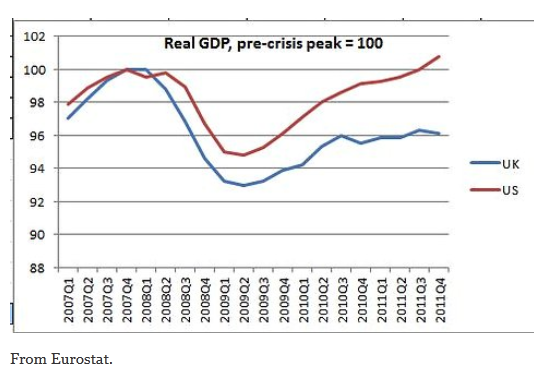
Keynesians like Paul Krugman produce an almost daily barrage of studies portraying the downside of austerity and statistics in which they compare countries that have embarked on austerity (much of the eurozone, Britain), versus countries that haven't, or have done so with a great deal less zeal (the US). Here, for instance, is his figure comparing the UK (austerity) with the US:
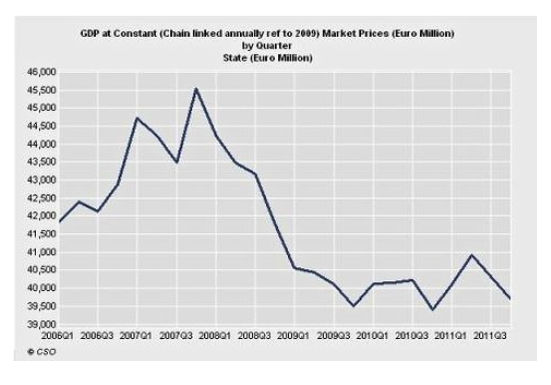
Or, the poster child of the austerity people, Ireland, where that is supposed to have lead to an economic recovery:
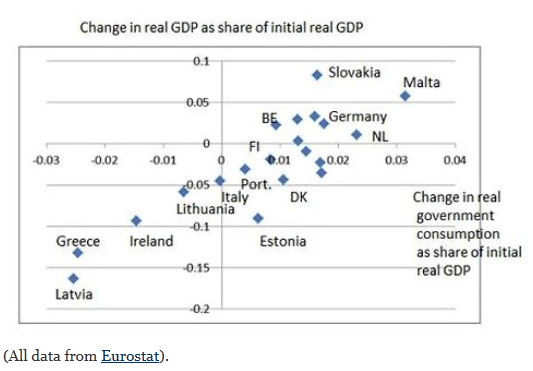
In general, there seems to be a positive relation between public spending and GDP under the present conditions:
It is somewhat surprising that much of the evidence doesn't seem to have been taken on board by policy makers. In fact, those arguing for more fiscal expansion seem, after a brief day in the sun in 2008-9, in retreat, at least in the policy arena. The Krugman insurgency seems well and truly over. This is somewhat unfortunate as the evidence really is on his side.
We have discussed the idea of expansionary austerity, basically the belief that cutting back public spending would automatically be more than compensated by a private sector revival. Under balance sheet recession conditions where interest rates are extremely low, there is no reason to believe this will be happening and no evidence in support.
The only case where this could be said to have happened was the case of Ireland in the late 1980s, were public austerity led to such a drop in interest rates (which were very high at the time) and the currency that they crowded in private spending and the economy was better off.
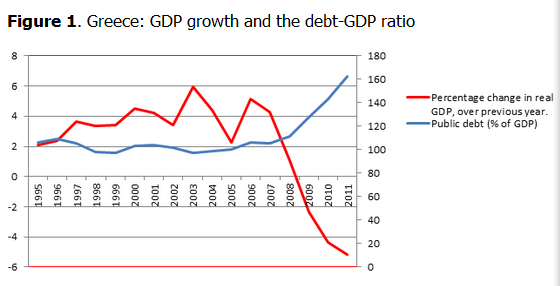
What we do see under balance sheet recession conditions, and especially under fixed exchange rates like the Euro system, is that austerity might be self-defeating even in the limited sense of its effect on public finances, that is, embarking on it worsens the economy so much that public debt levels only deteriorate, leading to more austerity and a sort of vicious cycle. Greece remains a prime example:
But also Italy, embarking on a whopping 3% of GDP austerity program, is experiencing strong negative growth and increases in public debt/GDP ratio as a result.
Conclusion
The present economic conditions where households (and banks) are absorbing the effects of the implosion of a large asset bubble which has impaired their balance sheets is a peculiar one in which the economy behaves differently than under normal conditions. Interest rates fall to record lows despite alarming public sector finances and as a result, monetary policy loses much of its traction.
However, these same conditions increase the effectiveness of fiscal policy, witness the disappointing outcomes of austerity experiments. It could, under certain conditions, even be argued that a fiscal stimulus could pay for itself.

Sunday, March 25, 2012

Rick Santorum Continues To Demonstrate As The Anti-Christ!

Santorum continues to lie, and deceive voters every chance he can. For a man who portrays himself as a devote Christian, he demonstrates something very different. He appears to be the Anti-Christ. He lies continuously. He exaggerates the truth. Is this what a devote Christian does? Is this what a committed religious person does? Is this the behavior a father wants to show his children who stand behind him on the stage of America?

Santorum is a fake and a fraud!!!!!!!!!

Watch this Santorum created "Obamaville" video.


This is another example of Rick Santorum's lies.


Is the health care law constitutional?

 Yes, it expands liberty

by Gary Kaplan 3-25-12, from the Post Gazette

According to Rick Santorum, unless repealed by Congress or revoked by the Supreme Court, health care reform -- i.e., "Obamacare" -- "will be the end of liberty in our country." Mitt Romney attempts to distinguish Obamacare from the nearly identical Romneycare he enacted as governor of Massachusetts on the basis of pre-Civil War notions of unfettered states' rights.


Central to the debate over federal health care reform is the "individual mandate." Beginning in 2014, the law will impose a penalty on adults who can afford health insurance but choose not to buy it.
The mandate was not intended to punish uninsured Americans for making bad decisions. It was needed to preserve the private market for insurance as new rules kick in to prohibit denial of coverage because of pre-existing conditions and termination of coverage in the face of catastrophic illness. In a nutshell, the mandate spreads the risk, thereby reducing the cost, of expanded health coverage.
Mr. Santorum complains that, regardless of its benefits, the individual mandate "is not the American way of doing things." Republican attorneys general from 26 states agree and have sued to have Obamacare struck down as unconstitutional. This narrow conception of "the American way" was not, however, shared by the founding fathers.
Shortly after ratification of the Constitution, the U.S. government required some citizens to purchase private goods and, yes, health insurance, when necessary to the nation's well-being.
The Second Congress enacted, and President George Washington signed, The Militia Acts of 1792, which required "every free able-bodied white male citizen of the respective States" to join their state militias and "provide himself with a good musket or firelock, a sufficient bayonet and belt, two spare flints, and a knapsack, a pouch, with a box therein."
In 1798, President John Adams signed into law "An Act for the Relief of Sick and Disabled Seamen," which required privately employed seamen to pay a portion of their wages into a government fund "for the temporary relief and maintenance of sick or disabled seamen, in the hospitals or other proper institutions."
Likewise, the Supreme Court upheld a health care mandate more than 100 years ago.
In 1905, the court found in Jacobsen v. Massachusetts that a state did not impinge on an individual's constitutional rights by mandating vaccination from smallpox (and penalizing those who refused to comply). The Supreme Court explained "liberty, the greatest of all rights, is not unrestricted license to act according to one's own will. It is only freedom from restraint under conditions essential to the equal enjoyment of the same right by others."
History also shows that the modern-day GOP's conflation of liberty and "states' rights" is not just false, but offensively so. Under the rubric of such "liberty," conservatives of different eras opposed federal child labor laws, minimum wages, consumer protection, anti-discrimination laws and the abolition of slavery.
The Constitution, however, was built on compromises between those seeking and opposing a strong, unifying federal government. While conservatives routinely rewrite history to credit only one side of that debate, more than 200 years of history, the Civil War, women's suffrage, the New Deal, Social Security, the Civil Rights Act of 1964, Medicare, Medicaid, the Americans with Disabilities Act and the Patriot Act (among others) belie their claims.
Until the individual mandate was adopted by the Obama administration, the GOP had no difficulty reconciling it with liberty.
One Republican bill (SB 1743, Nov. 20, 1993), co-sponsored by such progressive senators as Strom Thurmond and Jesse Helms, would have required employers to deduct mandated insurance premiums from wages for payment to "the employee's chosen insurer," while another required that "each individual citizen shall be covered under a qualified health plan or an equivalent health care program" (SB 1770, Nov. 23, 1993).
Newt Gringrich argued in 2006 that "individuals without coverage often do not receive quality medical attention. ... We also believe strongly that personal responsibility is vital. ... Individuals who can afford to purchase health insurance and simply choose not to place an unnecessary burden on a system that is on the verge of collapse; these free-riders undermine the entire health system by placing the onus of responsibility on taxpayers."
In short, health care reform poses no threat to liberty and may be essential to its preservation.
In the 1960s, Congress taxed everyone to establish Medicare because private insurers would not, and could not afford to, provide health insurance to the elderly. In 1974, President Nixon wrote to Congress:
One of the most cherished goals of our democracy is to assure every American an equal opportunity to lead a full and productive life. Without adequate health care, no one can make full use of his or her talents and opportunities. It is thus just as important that economic, racial and social barriers not stand in the way of good health care as it is to eliminate those barriers to a good education and a good job. ... For the average family, even normal care can be a financial burden while a catastrophic illness can mean catastrophic debt. Comprehensive health insurance is an idea whose time has come in America.
Since that time, progressively rising costs have deprived ever more Americans of meaningful access to health care and forced others into bankruptcy. To now pretend that our health care system will somehow correct itself or that avoidable disease and unnecessary deaths are preferable to mandated insurance is to confuse liberty with irresponsibility.
Gary Kaplan is a Pittsburgh health law attorney who teaches as an adjunct faculty member at Carnegie Mellon University and blogs at healthlawdx.com.
(http://eye-on-washington.blogspot.com)

Monday, March 12, 2012

Rush Limbaugh--America's Number One Hater!! Here are his sponsors.

From Thinkprogress.org

These sponsors have bailed:

So far, Sleep NumberThe Sleep Train, Quicken Loans, Legal Zoom, Citrix, Carbonite, ProFlowers, Tax Resolution, AOLBonobos, SearsAllstate Insurance, Sensa, Bare Escentuals, Vitacost, Hadeed Carpet, Thompson Creek Windows, PolyCom, Service Magic, AccuQuote Life InsuranceGeico, John Deere, Stamps.com, St. Vincent’s Medical Center, Bethesda Sedation Dentistry, Cascades Dental, Philadelphia Orchestra, Goodwill Industries, Heart & Body Extract, Netflix, Downeast Energy, Capitol OneJCPenney, Matrix Direct, Reputation Rhino, Consolidated Credit, Constant Contact, RSVP Discount Beverage, Cunningham SecurityRegal Assets, Freedom Debt Relief, Norway Savings Bank, Portland Ovations, The Girl Scouts of Oregon and Southwest Washington,O’Reilly Auto Parts, Aetna, TurboTax, New York Lottery, American Heart Association and the Aquarium of the Pacific have pulled ads from the program.

Here is a list of Limbaugh's current sponsors.

Proflowers has now pulled their sponsorship.
ProFlowers
Email http://www.proflowers.com/ContactUs.aspx?ref=homenoref
Web contact form
Sales or Service: 1-800-580-2913
Phone: 800.580.2913

Sleep Train pulled their advertising from Limbaugh

Sleep Train (Mattress Center)
4350 Warehouse Ct., Ste 100
North Highlands, CA 95660
Phone: (800) 919-2337
Fax: (866) 293-5719
Web contact form

eharmony
300 N. Lake Ave., Suite 1111
Pasadena, CA 91101
media@eharmony.com

usersupport@eharmony.com
Web contact form
Email
626.795.4814
FAX 626.585.4040


CANCELLED
CARBONITE, Inc.
617-587-1100
177 Huntington Avenue, Boston, MA 02115
david.friend@carbonite.com
Direct Dial Office: 617-587-1100 EXT:1115

Here is the second sponsor to cancel its sponsorship!

Sleep Number Bed
Select Comfort Corporation
6105 Trenton Lane N
Minneapolis, MN 55442
Phone: 763-551-7000
Fax: 763-551-7826
800-438-2233
investorrelations@selectcomfort.com

http://www.sleepnumber.com/eng/aboutUs/redirect.cfm?sectionID=contact/contact.cfm


Oreck Upright Vacuum Cleaners
Oreck Corporation
100 Plantation Road
New Orleans, Louisiana 70123
Online contact form

http://www.oreck.com/Customer-Service

800-289-5888

Mid-West Life Insurance Company of Tennessee
9151 Grapevine Hwy.
North Richland Hills, TX 76180
Phone (800) 733-1110
(web banner ads on rushlimbaugh.com)

https://www.midwestlife.com/contact-mid-west


AutoZone Inc.
901-495-7185; Fax: 901-495-8374
P.O. Box 2198, Memphis, TN 38101
investor.relations@autozone.com

Another sponsor canceling from the show

LegalZoom/Quicken Loans
800-773-0888; Fax: 323-962-8300
Site has a Web Form

http://legalzoom.force.com/LZWTC


CANCELLED

Citrix Online (GoToMyPC)
6500 Hollister Avenue, Goleta, CA 93117
Phone: 805-690-6400; Fax: 805-690-6471
info@citrixonline.com

American Forces Network
Contact Us: @MyAFN.net

http://myafn.dodmedia.osd.mil/email.aspx


Mission Pharmacal has pulled their sponsorship

Mission Pharmacal Company
10999 IH-10 West Suite 1000
P.O. Box 786099
San Antonio, TX 78278-6099
Telephone: (800) 531-3333
Bennett Kennedy - Citracal Product Manager

http://www.missionpharmacal.com/contact-us


Life Quotes, Inc.
32045 Castle Court
Evergreen, CO 80439
1-800-670-5433
info@lifequotes.com.au

Lending Tree
(704) 541-5351
Online Contact page

http://www.lendingtree.com/about-us/contact-us/email-customer-care/


AOL-CANCELLED


TAX RESOLUTION SERVICES--CANCELLED


"The latest advertisers who have “suspended” [This doesn't mean quit.] their advertising from Limbaugh’s show include Citrix Online and all its businesses, including the popular GoToMeeting and GoToMyPC.  Yesterday, the privately-owned online retailer that sells legal documents and services with annual sales over $100 million, Legal Zoom, the Cleveland Cavaliers professional basketball team and Quicken Loans, both headed by Dan Gilbert joined the boycott and suspended their advertising. And two different mattress companies, Sleep Number, and The Sleep Train – which deserves credit for being the first to have the courage to stand up to Limbaugh — have ask either exited or suspended advertising with Limbaugh." Read more here.


Here is another list:


LIMBAUGH’S SPONSORS  The source is here.
Lending Tree:  704-541-5351
Web Form Email: http://www.lendingtree.com
Life Quotes:  800-670-5433
e-Harmony:  626-795-4814; Fax: 626-585-4040
usersupport@eharmony.com
OnStar:  800-947-AUTO
Hotwire Corporate Headquarters:  877-468-9473
333 Market Street, Suite 100, San Francisco, CA 94105
advertising@hotwire.com
CARBONITE, Inc.:  617-587-1100
177 Huntington Avenue, Boston, MA 02115
david.friend@carbonite.comDirect Dial Office: 617-587-1100 EXT:1115
Select Comfort: 763-551-7460
d/b/a Sleep Number Bed:  800-438-2233
Oreck Corporation:  800-289-5888
100 Plantation Road, New Orleans, Louisiana 70123
Smart & Final, Customer Relations
PO Box 512377, Los Angeles, CA 91001-0377
(Heard on KFI 640 in Los Angeles)
AutoZone Inc.:  901-495-7185; Fax: 901-495-8374
P.O. Box 2198, Memphis, TN 38101
investor.relations@autozone.com
Mission Pharmacal (Citrical):  800-531-3333
P.O. Box 786099, San Antonio, TX 78278-6099
LegalZoom
800-773-0888; Fax: 323-962-8300
Site has a Web Form
Blue-Emu:  800-432-9334
Citrix Online (GoToMyPC)
6500 Hollister Avenue, Goleta, CA 93117
Phone: 805-690-6400; Fax: 805-690-6471
info@citrixonline.com
American Forces Network
Contact Us: @MyAFN.net
http://myafn.dodmedia.osd.mil/
ADDITIONAL:
Show Your Support to Rush’s Sponsors (his site)
http://www.rushlimbaugh.com/
List of Radio Stations that Air Him
http://www.rushlimbaugh.com/
FCC Consumer Complaint:
http://esupport.fcc.gov/
Includes “Obscene or indecent programs” and “unfair/biased” broadcasts.
Syndicated By:  1) Premier Radio Networks:  818-377-5300
http://www.premiereradio.com/
Corporate office:  15260 Ventura Blvd., Sherman Oaks, CA 91403
Syndicated By:  2) Clear Channel:  210-822-2828
http://www.clearchannel.com/Corporate Office: 200 East Basse Road, San Antonio, TX 78209
(http://eye-on-washington.blogspot.com)